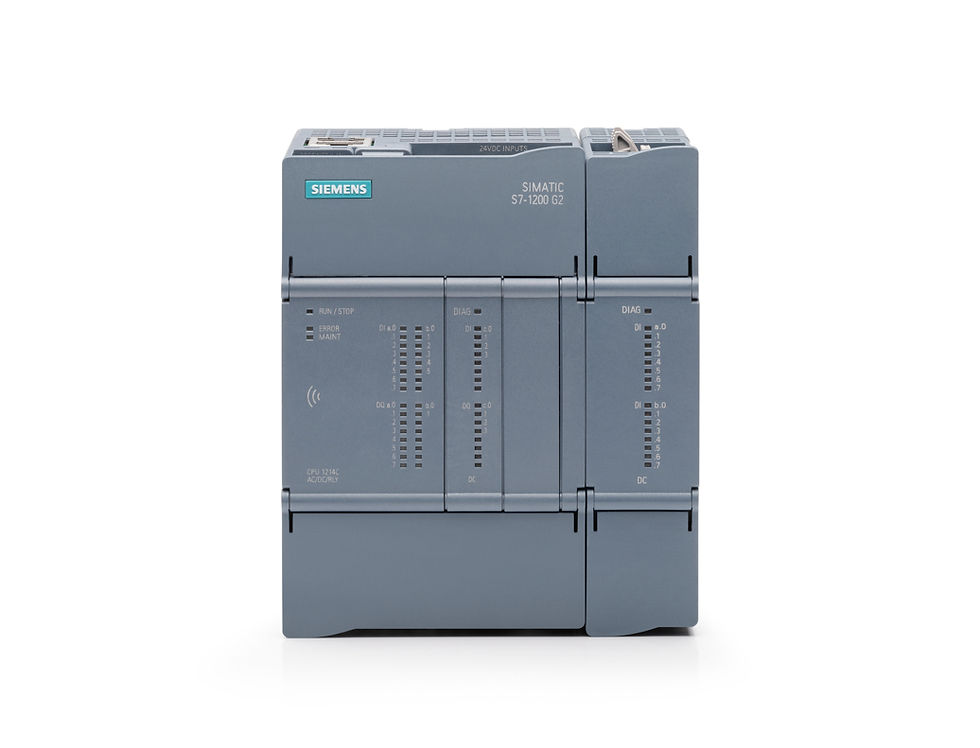
How a Programmable Logic Controller (PLC) Works
A Programmable Logic Controller (PLC) is a purpose-built, ruggedised industrial control system designed for deterministic, real-time control of machinery and processes operating in harsh environments. Originally developed in the late 1960s to replace hard-wired relay panels, PLCs significantly reduced installation time, wiring complexity, and modification effort by shifting control logic into software. Today, PLCs form the backbone of discrete, batch, and continuous automation systems across manufacturing, utilities, and infrastructure sectors.
Core Functions
A PLC continuously performs three primary functions within a real-time control loop: it samples input signals from field devices such as sensors, switches, and transmitters, executes a deterministic user-defined control program stored in non-volatile memory, and updates outputs to control actuators including motors, valves, and indicators. These operations occur repeatedly and predictably, forming the basis of reliable industrial control.
System reliability is ensured through watchdog timers, internal diagnostics, error-checking routines, galvanic isolation of input/output channels, and environmental hardening in accordance with IEC 61131-2. This allows PLCs to operate across wide temperature ranges and in environments with high vibration or electromagnetic interference.
Core Hardware Components
The PLC hardware architecture is modular and designed for robustness and scalability. The CPU or processor module is responsible for executing the control program, managing memory and I/O image tables, handling communications, and performing system diagnostics. Modern PLC CPUs support multitasking, high-speed processing, and integrated motion or safety functions.
Input modules interface with field devices and support a wide range of signal types, including digital signals (such as 24 VDC or 120 VAC), analog signals (including 4–20 mA and 0–10 V), and temperature inputs from RTDs or thermocouples. These signals are conditioned, electrically isolated, and converted into digital values which are stored in the Input Image Table.
Output modules perform the inverse function, converting control signals from the CPU into physical outputs, whether digital (relay, transistor, or triac-based) or analog, with commands buffered in the Output Image Table prior to being written to the field. A regulated power supply, typically 24 VDC, provides stable power to all system components and incorporates protection features such as brownout detection and energy hold-up.
All modules are interconnected via a high-speed backplane or rack system, enabling deterministic communication between the CPU and I/O modules. Engineering access is provided through programming environments such as Siemens TIA Portal, Rockwell Studio 5000, or Codesys, allowing online monitoring, diagnostics, forcing, and firmware updates.
The PLC Scan Cycle – Deterministic Execution Model
PLCs operate using a deterministic scan cycle, also referred to as the program cycle or sweep, which typically executes within a time frame of 1 to 100 milliseconds depending on program complexity, I/O count, and processor capability. This scan cycle underpins the predictable behaviour of the control system.
During the input scan phase, the PLC reads the state of all physical inputs and copies these values into the Input Image Table, creating a consistent snapshot of the system state which remains unchanged for the duration of the scan. During program execution, the PLC processes the user logic sequentially using only the stored input image and internal memory, updating internal variables, timers, counters, and the Output Image Table. During the output scan phase, the PLC writes the contents of the Output Image Table to the physical outputs, ensuring that all outputs change state simultaneously and without intermediate glitches.
Many systems also include a housekeeping phase for communications, diagnostics, and HMI updates, although this occurs outside the critical deterministic loop.
Key Engineering Principle: Image Tables
The use of input and output image tables decouples physical I/O from program execution, eliminating race conditions and ensuring that input changes occurring mid-scan do not affect the current execution cycle. This guarantees deterministic and repeatable system behaviour.
For example, in a conveyor control application, if a fault condition such as an overload occurs during logic execution, the PLC will complete the current scan using the previously captured input state and then safely update the outputs at the end of the cycle, preventing erratic or unstable operation.
Programming Languages (IEC 61131-3)
PLC programming is standardised under IEC 61131-3, which defines multiple languages to suit different application requirements. Ladder Diagram remains the most widely used language for discrete control due to its similarity to relay logic and ease of troubleshooting.
Function Block Diagram is commonly used in process and analog control applications, while Structured Text provides a high-level, text-based approach suited to complex algorithms and data manipulation. Sequential Function Chart is used for step-based and procedural control, particularly in batch processes.
Instruction List, previously included as a low-level textual language, has been deprecated and removed in the latest edition of the standard. Modern PLC platforms typically support multiple languages within a single project.
Why PLCs Dominate Industrial Control
PLCs dominate industrial automation due to their deterministic real-time performance, high reliability, and engineering efficiency. Unlike general-purpose computers, PLCs provide predictable response times and are specifically designed for continuous operation in demanding environments.
Their modular architecture allows systems to scale from small standalone controllers to large distributed control systems with thousands of I/O points. Integrated diagnostics, online monitoring, and software-based modification significantly reduce commissioning time and maintenance effort.
Safety-rated PLCs further extend capability by enabling implementation of functional safety systems up to SIL 3 or PL e, incorporating certified safety functions such as emergency stops and light curtain monitoring.
PLC vs. Traditional Relay-Based Control
In comparison to traditional relay-based control systems, PLCs offer substantial advantages. Relay systems require extensive point-to-point wiring and are difficult to modify, whereas PLC-based systems reduce wiring complexity and allow changes to be implemented in software.
Fault diagnosis in relay systems is typically manual and time-consuming, while PLCs provide real-time diagnostics and data visibility. Although relay systems offer near-instantaneous response, PLC response times are sufficiently fast for most industrial applications and are offset by improved flexibility, reliability, and maintainability.